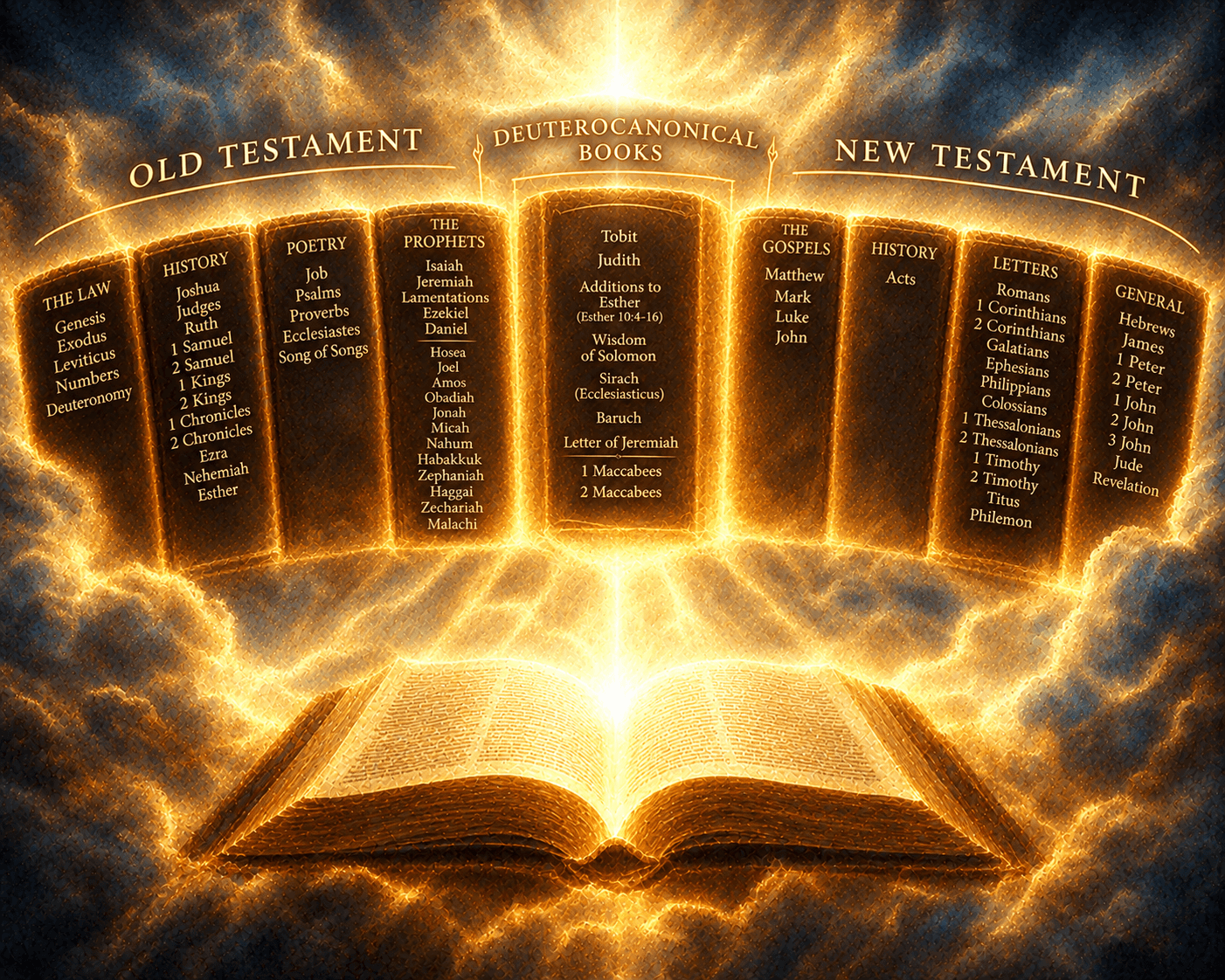
Before we can really look at the Scriptures, one question that needs to be asked is - how do we know what is the inspired Word of God?
While the question of what belongs in the Bible may seem straightforward, it actually encompasses a complex, overlapping set of issues regarding texts, versions, passages, and the stability of the scriptural canon.
Watch
If you prefer to watch then explore this section. If you prefer to read then scroll down.
Who Decided the Biblical Canon? - How the Catholic Church Set the 73-Book Bible
How the canon was discerned over time, from the early Church through the councils of Rome, Hippo and Carthage to Trent.
History of the WHOLE Bible in 9 minutes I guess…
A brief survey of how the Bible came to be.
The problem of the Biblical Canon
Old Testament: variations and versions
Christians do not all read the same Old Testament. They differ both on which books belong in it and on which text of those books to follow.
The Protocanonicals
Almost all modern Christians agree on a core of 39 books (equivalent to the 24 or 22 books of the Hebrew Bible). Protestants accept only these books.Textual versions
Even when agreeing on the books, Christians differ on the underlying text. Protestants generally rely on the Hebrew Masoretic text, while the Orthodox Church favours the Greek Septuagint (which can differ significantly, such as the Book of Job being shorter). Catholics have historically utilised both (although the modern church generally prefers Hebrew).Deuterocanonicals and Orthodox additions
Catholic Bibles include 7 additional books (such as Tobit and Maccabees) and specific passages (portions of Daniel and Esther), totalling 46 books in the Old Testament. Orthodox Bibles generally go further, including additional texts like 3 Maccabees, 1 Esdras, and varying regional additions (such as Enoch or Psalm 151 in the Ethiopian or Russian traditions).
New Testament: historical evolution
Christians today largely agree on the New Testament, but its boundaries were less settled in the Early Church, where some of its books were disputed and some texts now outside it were read as Scripture.
The 27-book consensus
Almost all modern Christians accept a standard 27-book New Testament. However, seven of these books (such as Hebrews and Revelation) were disputed in the Early Church.Early alternatives
Early Christians occasionally treated other texts - like The Shepherd of Hermas, the Didache, or the Epistle of Barnabas - as Scripture, raising the question of whether the Early Church was overly restrictive in excluding texts from Scripture.
Modern scholarship and textual challenges
Even an agreed list of books leaves questions open. Modern scholarship asks who wrote some of them and which passages are original, while some groups claim to have further Scriptures.
Apostolic authorship
Many New Testament books (like the Pastoral Epistles, 1 and 2 Timothy, and Titus) were accepted based on apostolic authorship. Modern scholarship questions whether Paul actually wrote them, prompting the question of whether such texts (called pseudepigraphal texts) should lose canonical status.Later additions and removals
Textual criticism reveals that certain familiar passages - such as the story of the adulterous woman (John 8) or the ending of Mark (Mark 16) - are missing from the oldest surviving manuscripts, indicating they were later additions. While precedent exists for removing errors (like the Johannine Comma in 1 John), questions arise about whether other possibly non-original texts should be stripped from the Bible, or if doing so leaves the canon vulnerable to shifting archaeological discoveries.Potential new additions
Some modern Christians claim to have additional Scripture - such as the Book of Mormon. How should these be evaluated?
So the “problem of canonicity” is far deeper than a simple headcount of Protestant (66), Catholic (73), or Orthodox (75+) books. It involves debates over textual versions, disputed passages, authorship, and the criteria for editing or closing the canon. Because Scripture shapes the content of Christian faith, resolving these ongoing questions is fundamental to understanding Christian belief itself.
How can these questions be answered?
This raises the question of how Christians can answer questions about the canon.
Can they be answered by Scripture itself? No, as Scripture has no inspired table of contents (see here for further evaluation).
Can they be answered by Tradition? To some extent, yes (see here for more information). But some of the questions are new ones from recent times.
The only way we can really know what books are inspired, and therefore should be in the Bible, is by the authority of the Church that Jesus Christ founded.
A gradual process of recognition
The formation of the biblical canon of what is to be considered inspired Scripture was not a sudden decision; it was a gradual process of recognition and discernment carried out by the early Christian community over the first four centuries.
The role of Church councils
While widespread consensus on most of the New Testament (the four Gospels and core Pauline epistles) was reached very early (by roughly 200 AD), a few fringe books (like Revelation, Hebrews, or 2 Peter) faced local hesitation because their authorship or boundaries were debated.
To bring unity and official closure, regional and universal church councils formally ratified the lists that the Christian faithful had already largely adopted through custom and prayerful use:
The Synod of Rome
382 AD
Presided over by Pope Damasus I, this council issued a complete catalogue of Old and New Testament books that matches the modern Catholic Bible (but the records of this council date from much later). It led to the publication of the Vulgate Bible in Latin, which contained all the books of the Catholic Bible.The Councils of Hippo and Carthage
393 AD, 397 AD & 419 AD
Led largely by figures like St Augustine in North Africa, these regional councils reaffirmed the 46 books of the Old Testament and 27 books of the New Testament as canonical.The Council of Florence
1442 AD
During a time of reunion efforts, it issued a formal decree listing the canonical books.The Council of Trent
1546 AD
In response to the Protestant Reformation (which questioned the inclusion of the deuterocanonical books of the Old Testament), the Catholic Church dogmatically and definitively reaffirmed the traditional 73-book canon (46 Old Testament, 27 New Testament).
So the canon was agreed upon not by a sudden political decree, but through a centuries-long journey of the Church that used spiritual discernment, testing against apostolic truth, and liturgical practice. The Church looked at the books that best bore the authentic mark of Christ’s Apostles and stamped them with formal approval to ensure the faithful were nourished by a unified, error-free standard of truth.
Complete, but not yet explicit
Understanding the Revelation that Christ brought to us is still an ongoing process. The Catechism (1992) provides a helpful clarification of what Vatican II said about Revelation. It states:
“Yet even if Revelation is already complete, it has not been made completely explicit; it remains for Christian faith gradually to grasp its full significance over the course of the centuries.”
This explains how Revelation can be complete (in the Apostolic era) and how Church teaching can also continue to develop over time. That development is a matter of making “explicit” what was implicit in the original Revelation, which occurred in the Apostolic era.