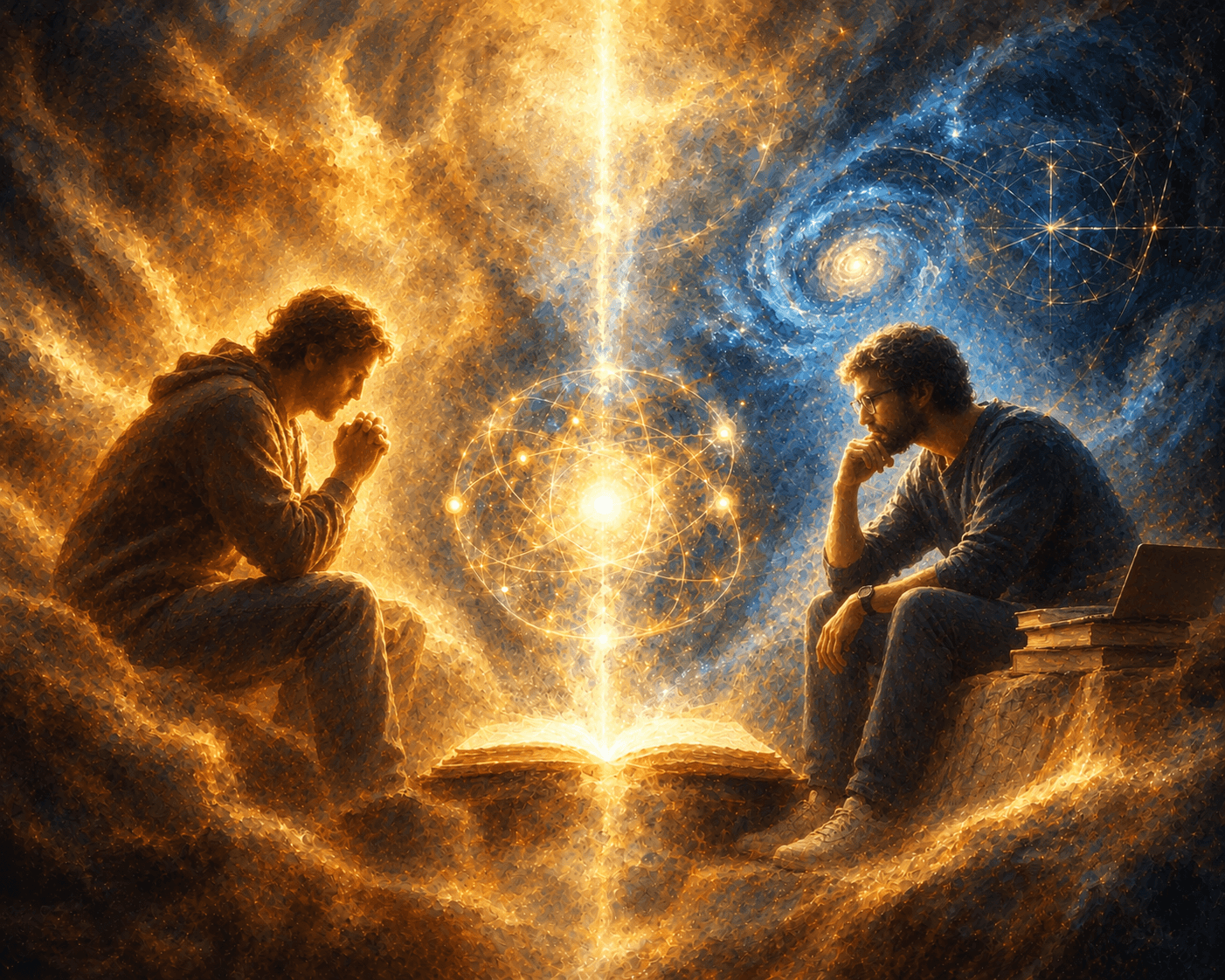
In Catholic theology, faith and reason are not opposed or in conflict, but are complementary ways of acquiring truth. Both come from the same source - God - and therefore cannot genuinely contradict each other.
Pope John Paul II summarised this relationship in the opening line of his 1998 encyclical Fides et Ratio:
“Faith and reason are like two wings on which the human spirit rises to the contemplation of truth”
Watch
If you prefer to watch then explore this section. If you prefer to read then scroll down.
St. Thomas Aquinas on Faith and Reason (Aquinas 101)
The Thomistic Institute. Fr Dominic Legge, OP, on whether it makes sense to believe, and the place reason has alongside faith, with Aquinas as the guide.
Bishop Barron on Faith and Reason
Bishop Robert Barron, of Word on Fire, on how faith and reason relate.
John Lennox - Faith And Reason
Prof John Lennox on faith and reason.
Natural Theology Developed: Defending Your Faith with R.C. Sproul
R.C. Sproul on why nature will never reveal something about God that contradicts Scripture, since God is the author of both.
Faith & Reason: Core principles
Unity of truth
Because God created the physical universe and revealed spiritual truths, scientific or philosophical truth can never contradict divine revelation. Apparent contradictions arise only from faulty reasoning, inaccurate science or a misunderstanding of scripture and doctrine.Reason prepares the way for faith
Reason allows humans to recognise God’s existence through the order, complexity, and beauty of the natural world (natural theology). It also helps confirm the credibility of historical claims in scripture and church tradition.Faith elevates and guides reason
Human reason is limited and its acceptance of first principles is distorted by sin (the fall). Faith introduces truths beyond the reach of human minds - such as the Trinity or the Incarnation - and provides a moral framework for intellectual enquiry.
Faith & Reason: Historical foundations
Early Church Fathers
St Justin Martyr & St Augustine
Early theologians used Greek philosophy (Platonism) to articulate Christian doctrines clearly. Augustine famously expressed the harmony as “I believe in order that I may understand, and I understand in order that I may believe.”Medieval Scholasticism
St Thomas Aquinas
Aquinas provided the classic Catholic synthesis of faith and reason in his Summa Theologiae. He demonstrated that while core mysteries of faith require revelation, core philosophical truths (like the existence of God or the natural moral law) can be known through human logic alone.The First Vatican Council
1869–1870
Responding to Enlightenment rationalism (which rejected divine revelation) and fideism (which rejected human reason in favour of blind belief), Vatican I defined that God’s existence can be known with certainty by the natural light of human reason. However, this depends on starting from correct first principles.Modern Catholic thought
Vatican II & John Paul II
Modern Catholic teaching strongly supports scientific endeavour, asserting that exploring the natural world honours God’s creation.
Because of this harmony, the Catholic Church has historically been a primary sponsor of scientific discovery. Many groundbreaking discoveries were made by Catholic clergy and scholars who viewed their research as an act of worship:
Gregor Mendel
An Augustinian friar who founded modern genetics.Georges Lemaître
A Catholic priest and theoretical physicist who first proposed the Big Bang theory.The Vatican Observatory
One of the oldest astronomical research institutions in the world, operated by Jesuit astronomers.
“For from the greatness and beauty of created things comes a corresponding perception of their Creator”
Fideism and rationalism
Catholicism rejects two extreme views regarding truth:
Fideism
RejectedDefinition
Relying exclusively on faith while dismissing human reason, logic, and evidence as irrelevant or harmful.The Catholic view
Fideism is a dangerous model of religion. Religious leaders can say anything when they don’t need to worry about making sense or providing evidence. Thus it opens the door to spiritual abuse, and it is often a model of religious faith proclaimed by cults.
Faith without reason can slide into superstition or fanaticism.
Rationalism
RejectedDefinition
Rejection of divine revelation, holding that human reason is the sole judge of truth.The Catholic view
Rationalism can end up being a bit arbitrary. There are many beliefs that people hold without any evidence at all. For example, who can prove that reality exists outside of human mindsor that other human beings have minds and consciousness like ourselves? These things cannot be proven by evidence, yet people can and do rightly believe such claims.
If human rationality has evolved as the product of a directionless, random process then why would this be seen to be reliable as a source of truth? Would we trust a machine that had been randomly and directionlessly produced?
However, Catholics believe that reason was given to us as a reflection of the mind of God, but it is still created and reason alone cannot grasp the full depth of divine love, grace, and redemption.
Natural theology: the middle way
Natural theology is the middle way between the two extremes of fideism and rationalism. It seeks to demonstrate truths about God using the “natural light of human reason” by observing the physical universe and applying logic but without relying on divine revelation or scripture. It serves as the foundational bridge where philosophy meets faith, proving that the existence of God is a reasonable, intellectually coherent conclusion rather than a matter of blind belief.
Knowledge from creation
“For since the creation of the world His invisible attributes... are clearly seen, being understood by the things that are made”
Based on passages like this, Catholicism teaches that the created world bears the imprint of its Creator. By observing causality, order, motion, and design in nature, human reason can deduce that God exists.
A Creator or an uncaused universe?
The choice between a Creator and an uncaused universe is a decision between two competing scientific/philosophical hypotheses. If someone asks, “Why is there a finely tuned, orderly universe governed by rational laws of nature rather than nothing at all?”, answering “It just is” or “It caused itself” leaves the most crucial question unanswered.
It could be argued that some current theories could be called “fideistic” (like infinite time models, infinite regress, or certain multiverse theories). These theories suggest that if given enough time, every possible arrangement of matter - no matter how improbably finely tuned for life - must eventually happen by pure chance. These beliefs could be called “fideistic” (relying on blind faith) because they rely on an unprovable, assumption: that mathematical possibility automatically guarantees physical reality over infinite time without any underlying mechanism driving it.
Catholics reject fideism and think that there are good reasons to believe in God. Asserting an eternal, intelligent Being (God) provides a grounding reason for why something exists rather than nothing, and why that “something” follows mathematical and rational laws.
Key areas of enquiry for natural theology
The existence of God
Formulating rational proofs for God, most famously St Thomas Aquinas’s Five Ways, which argue for God as the Unmoved Mover, the First Cause, and the Necessary Being.Divine attributes
Reason can deduce certain basic truths about God’s nature - namely that God must be one, eternal, immutable, omnipotent, immaterial, and perfectly good.The natural moral law
Natural theology extends to ethics, asserting that human reason can discern basic objective moral principles (e.g., that murder is wrong, or that justice is good) written into human nature itself.
Scope and limitations of natural theology
While Catholic theology highly values natural reason, it clearly defines its boundaries:
Preambles of faith
Natural theology provides the rational framework or foundation for faith. It can prove that God exists, but it cannot reveal who God is in His inner divine life.The need for supernatural revelation
Mysteries like the Holy Trinity, the Incarnation of Christ, or eternal redemption cannot be discovered through human philosophy alone. They require God to reveal them freely.The impact of the Fall
Catholic teaching recognises that human reason, though intrinsically good, is finite and darkened by original sin. Consequently, while humans can know God through reason alone, doing so without error, confusion, or distortion is difficult in practice - which is why God also revealed basic truths directly.